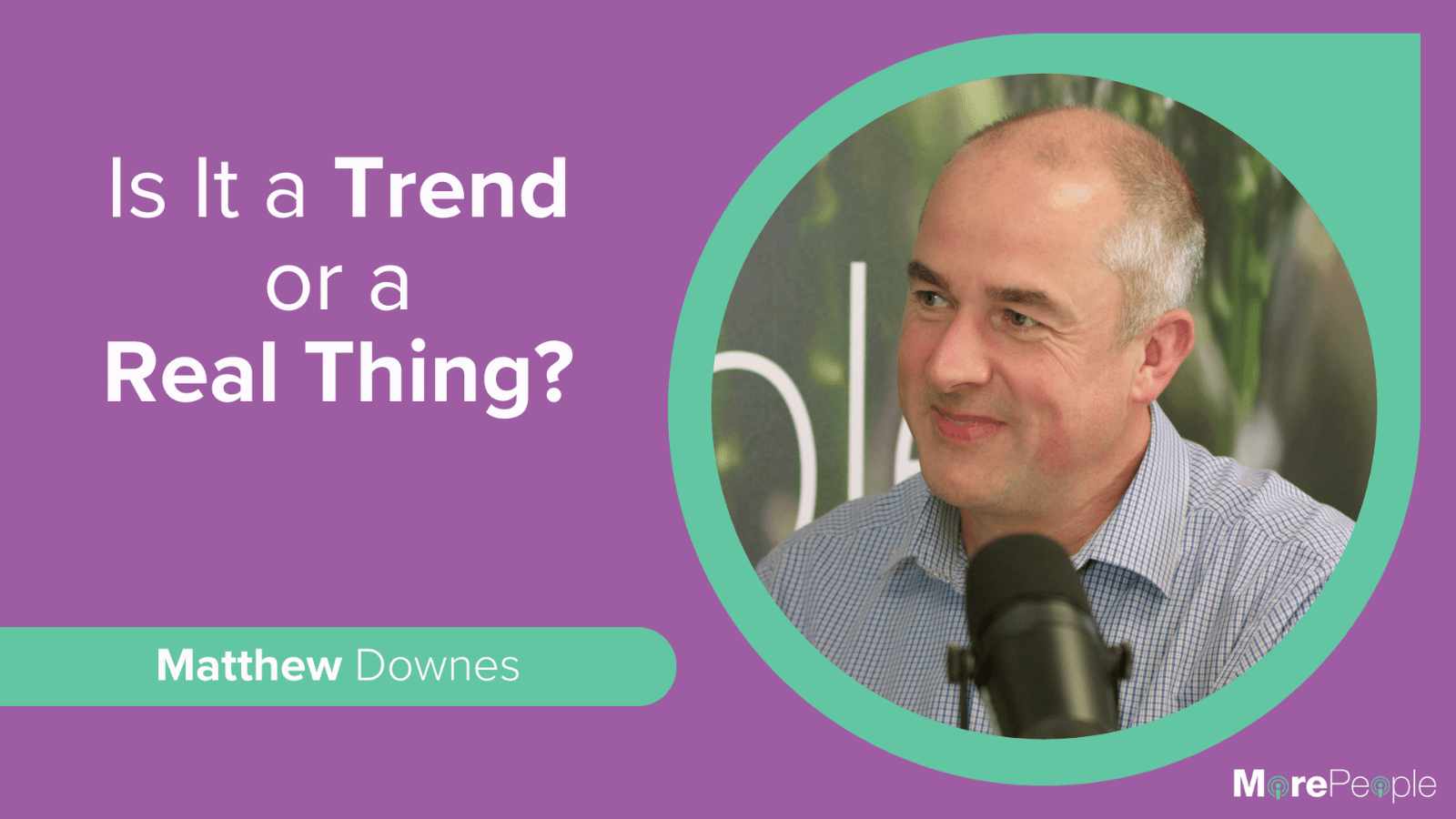
Episode 70: The MorePeople Podcast with Matthew Downes Part 1
Demystifying AI in Business: Insights from Matthew Downes, IT Director at Scala
Step into the world of career insights with The More People Podcast, where we explore strategies, innovation, and success stories across industries. In our latest episode, host Andrew Fitzmaurice sat down with Matthew Downes, IT Director at Scala, to discuss his career journey and the evolving role of AI in business.
From Computer Science to IT Leadership
Matthew’s career began with a degree in computer science from the University of Kent, including a year in industry. After a brief stint in insurance, he found his path in supply chain management, starting at Procter & Gamble. He then moved to Weetabix, where he worked in manufacturing, production planning, and WMS implementations.
His career later expanded internationally, leading North American operations and eventually spending ten years in third-party logistics (3PL) before transitioning into consulting. Today, Matthew brings this breadth of experience to his role at Scala, guiding businesses through technological transformation.
Understanding AI: Beyond the Hype
AI is often perceived as a new, disruptive phenomenon, but Matthew emphasises it’s the result of decades of evolution in machine learning and computing. While tools like ChatGPT have brought AI into the spotlight, the underlying technology has been developing for years, powered by vast computing resources and massive datasets from the internet.
“AI isn’t just ChatGPT. It’s an evolution. It’s transforming how we work, and while there’s hype, the impact will be real and lasting,” Matthew explains.
He highlights some staggering statistics: AI-related spending accounted for 90% of U.S. GDP growth in the past year, and data center electricity consumption is set to rise to 10% of total U.S. electricity by the end of the decade. Globally, McKinsey estimates $6.7 trillion in AI and IT infrastructure spending by 2030.
How AI Works: A Simplified Overview
Matthew breaks down ChatGPT as a “large language model” trained on 60 trillion words. Using a process that analyses context, word patterns, and attributes, it predicts the most likely next word to generate human-like text. While the technology is powerful, it’s inherently unpredictable and outputs vary based on phrasing, context, and prior interactions.
He also points out the critical need for human oversight:
“It’s a skill to learn, knowing what questions to ask and how to analyse the answers. Just as we learned to search effectively on Google, we now need to learn how to interact with AI responsibly.”
AI in Business: Opportunities and Challenges
Matthew sees practical AI adoption starting with tools like ChatGPT and Microsoft Copilot. For example, consultants can leverage AI to design warehouses or optimise logistics solutions. He also highlights tools like Perplexity, which provide source-backed AI responses, helping businesses make more informed decisions.
Energy consumption is another consideration, given the massive computing power AI requires. Companies like Rolls Royce are even exploring modular power solutions to sustainably support data centers, emphasising the importance of “green thinking” in AI adoption.
The Future: Skills and Adoption
Matthew stresses that organisations and individuals should engage with AI early, experimenting with different tools and developing analytical skills to evaluate outputs critically. For businesses, this means understanding AI’s potential, identifying applications, and creating strategies for responsible adoption.
“The earlier you start experimenting, the better. AI is here to stay and understanding it will be a key differentiator for businesses and careers alike.”